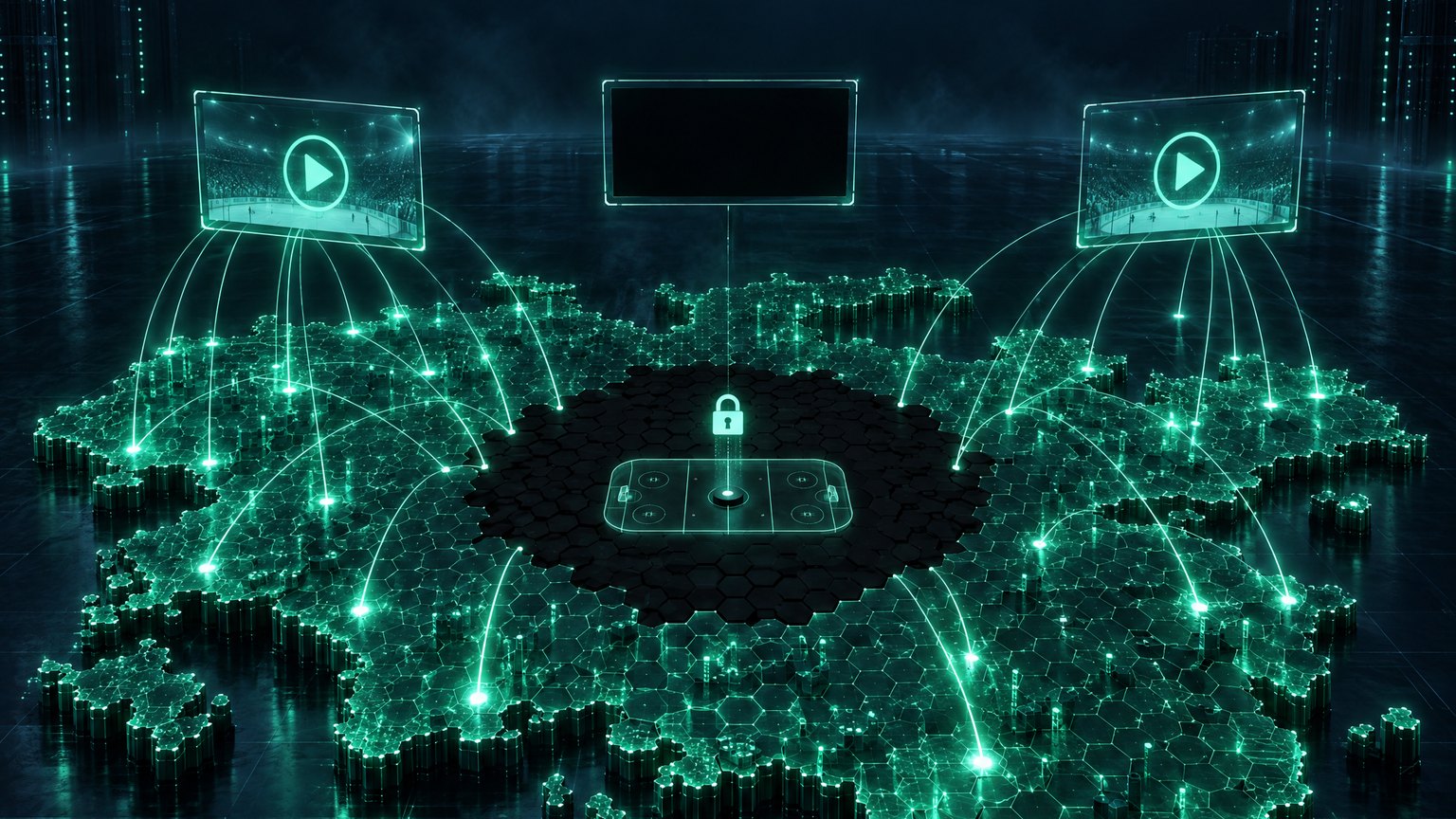
The NHL regular season opens on Tuesday, Sept. 29. NBA opening night follows on Tuesday, Oct. 20. On both nights, fans will open a streaming service they pay for, go to their own team’s game, and find it blocked.
That is not a bug. It is a blackout, one of the least understood rules in sports broadcasting, and one of the most consequential for anyone building a “where to watch” feature for US audiences. Outside North America the idea barely exists. Inside it, it decides what millions of fans can see every night of the season.
This is the first part of a series that goes through the major US leagues one by one. Before the league detail, the basics: what a blackout is, why it exists, and why the answer changes from one ZIP code to the next.
What is a blackout?
A blackout means a game is deliberately made unavailable on a particular service in a particular place, because somebody else holds the exclusive right to show it there. There are two main kinds.
The local blackout. Every major US league sells an out-of-market package: NBA League Pass, MLB.TV, NHL Power Play on the ESPN App, NFL Sunday Ticket on YouTube. The name says what they are for. They carry the games of teams outside your area. The games of the team or teams whose home territory you are in are blocked, because the local rights to those games belong to a local broadcaster.
The national blackout. When a game is sold to a national partner as an exclusive, it disappears everywhere else. NBA League Pass in the US blacks out every nationally broadcast game, not just local ones. In the NHL, ESPN holds 100 exclusive national games in 2026-27 and TNT holds 72.
Local rights protect one buyer inside a territory. National exclusives protect another buyer across the whole country. A single game can sit under both.
A third thing gets called a blackout but is not one: a carriage dispute. When Disney’s channels, including ESPN and ABC, went dark on YouTube TV for about two weeks from Oct. 30, 2025, that was a fee dispute between a network and a distributor. The rights did not change. Only one route to them closed.
Why does it exist?
Because US sports rights are sold in layers. The league sells national packages. Each team sells its own local rights, traditionally to a regional sports network or a local TV station. Each buyer pays for exclusivity, and the blackout is the mechanism that enforces it.
The original reason was ticket sales. In 1953 a federal court upheld the NFL’s practice of blacking out home games in the local market, calling “reasonable protection of home game attendance” essential. From 1973, federal law required a home game to be shown locally if it had sold out at least 72 hours before kickoff. Games that did not sell out stayed dark. The FCC repealed its own supporting rule in 2014, noting that TV revenue had replaced ticket sales as the NFL’s main income, and the NFL suspended its sellout blackout policy the following year.
The attendance logic faded. The layered rights market did not. Today’s blackouts are about protecting the value of a contract, not the gate.
For a European reader, picture a football club selling its home matches only to its own app, available only inside a set radius of the stadium, while fans outside that radius watch the same club through a league-wide package that blocks every match played close to home. Now apply that to every team in the league, with each team’s radius drawn differently.
Where is “home”? Not where you think
Home is not a city. It is a territory drawn by the league, and it can be very large.
MLB assigns each club a home television territory mapped to ZIP codes, and the restrictions apply whether the club is home or away. The results are not always intuitive. Iowa has no MLB team, but it sits inside the territories of six: the Cubs, White Sox, Cardinals, Royals, Twins and Brewers. A fan in Des Moines who buys the out-of-market package still has all six blocked.
The NFL works differently again. On Sunday afternoons, CBS and FOX each show several regional games at the same time, and which game a market receives changes from week to week. The coverage maps are published every week by the independent site 506 Sports, and they are the closest thing to a public record of which game reaches which part of the country.
The NHL publishes a ZIP and postal code lookup so fans can see which teams are local to them. The fact that the tool exists says a lot about how hard the answer is to guess.
How does the app know where you are?
The package decides based on where you are, and each service measures that in its own way.
- ESPN, which now sells both MLB.TV and NHL Power Play, determines location by IP address.
- NBA League Pass applies blackouts based on your current location. If your location changes, so do your blackouts.
- YouTube TV, the home of NFL Sunday Ticket, asks for a home ZIP code at sign-up and may verify it through device location. Local networks follow where the device is. Subscribers have to stream from their home area at least once every three months, and can change their home area only twice in 12 months.
That produces a situation a fan can walk straight into. Take someone who lives far from their team’s territory and follows it through the out-of-market package. At home, the games are there. On a trip to the team’s own city, the same subscription blocks the same games, because on location-based services the viewer is now in-market. The team did not change. The fan’s location did.
Why 2026-27 is a reset year
The rules are not only complicated. They move, and this season they have moved a lot.
In spring 2026, Main Street Sports Group, operator of FanDuel Sports Network, the largest group of regional sports networks in the US, told teams it would cease operations. Its nine MLB clubs had already terminated their contracts in January over missed payments. Thirteen NBA teams and six NHL teams needed a new local home for 2026-27.
They did not all land in the same place:
- In the NHL, four of the six teams now have local games produced by the league itself, through NHL Productions. Detroit moved to a team-owned network and Nashville to over-the-air TV. The Kings stayed on the same channels, now run by baseball’s Angels.
- Prime Video became the in-market streaming home for six NHL teams, two of them arriving after the free streaming service Victory+ shut down on Sept. 1, 2026.
- In the NBA, the Pistons returned to over-the-air television for the first time since 2005. The Hornets and Magic moved to local over-the-air stations as well.
- In MLB, the league itself now produces local games for 14 clubs, and all 30 teams offer an in-market streaming option.
MLS went the other way entirely. From 2026, every MLS match is included in a standard Apple TV subscription, with no blackouts. It is the clearest sign of what a US league looks like when it pools its local rights, and also a reminder that it is the exception.
What this means for “where to watch” data
For most competitions, “where can I watch this?” resolves by country. In the US it resolves by territory, by service and by broadcast window, and the territory can be as small as a ZIP code.
That makes the real lookup key something like (game, viewer location, service, national window). A fixture feed carries none of the last three. It will tell you when and where a game is played. It will not tell you that a viewer in Des Moines is blocked from six teams on the package they pay for, that a Sunday afternoon NFL game reaches some markets and not others, or that a team’s local broadcaster changed over the summer because its previous one stopped operating.
That is the distinction worth repeating: sports data describes what is happening. Broadcast data describes who is allowed to show it, where, to whom, and on what terms. In the US, that second dataset is rebuilt a little every season.
Over the coming weeks, this series goes league by league, starting with the NHL and the NBA as their seasons open, then the NFL, MLS and MLB. Each has its own rules, and each has changed something this year.
If your platform needs to answer “where can I watch this” for US fans, game by game and market by market, that is the dataset we maintain. Get in touch.